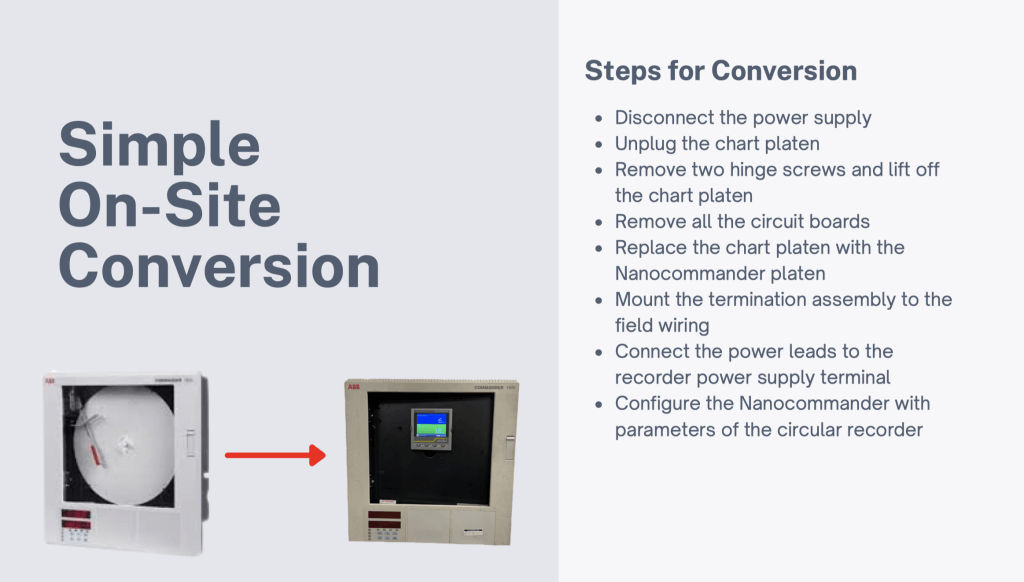
Nannocommander: On-Site Conversion
March 3, 2022 | Product News

LNG Turbo Expanders and Other Cryogenic Systems
As the popularity of natural gas has increased for heating and power generation, there has been strong demand for production and transportation of natural gas throughout the world. To transport natural gas around the world, it is liquefied using cryogenic processes to around -162°C and its volume is decreased by 600 times at LNG facilities to allow for safe and economic transportation, predominantly using LNG tankers.
Cryogenic processing of natural gas (mainly methane) is done in LNG liquefaction plants wherein the unwanted components (carbon dioxide, nitrogen, water, and a range of other unwanted components) are removed, and the heavier hydrocarbons separated prior to liquefaction and transportation. During this cryogenic processing, turbo expanders are used to remove energy from the LNG system and produce power at the same time. Metrix Vibration has the best speed and position monitoring for these cryogenic applications.
Vibration Monitoring of LNG Cryogenic Systems
Various machine trains are used in LNG plants during cryogenic liquefaction and compression processes. Vibration monitoring of these important machines is the most effective way of ensuring they are functioning efficiently and have no unscheduled downtime resulting in a loss of revenue.
Metrix Vibration provides the vibration monitoring systems which can enable LNG plant personnel to effectively monitor the machinery used in the cryogenic processing of natural gas. This includes the refrigeration trains, turbo expanders, and other rotating and reciprocating equipment used at the plant.
This application page and the attached documents are intended to outline the specifics regarding the speed, vibration and position systems used in LNG Cryogenic applications.
The Metrix Cryogenic Proximity Systems are rugged and industry proven proximity sensor systems. From the factory, Metrix has done several things to help ensure the proximity systems are easy to install and provide excellent data – such as providing interchangeable parts, preventing cross talk, adjusting pulse height to improve phase trigger and speed performance, providing high pressure feedthroughs and many other enhancements. Please refer to the Documentation tab below to learn more.
The Metrix Cryogenic Proximity System is a 9, 10, 12 or 18-meter system that is designed to take advantage of the Metrix Digital Proximity System.
For more information on Metrix, contact us here!
The Dräger PointGard 2100 series is a self-contained gas detection system for the continuous area monitoring of toxic gases in ambient air. PointGard 2100’s rugged, water-resistant housing comes complete with a horn and strobes, a built-in power supply, and reliable DrägerSensor®.
PointGard is a self-contained gas detection alarm system that is easy to install and commission. Ready to use out of box! Just mount it on a wall and hard wire it to an AC/DC power or plug in the optional AC power cord. Since the strobes and horn are built in, there is no need to specify and purchase separate alarm output devices. The pre-calibrated sensor is ready to use.
Flexible communications means the PointGard can accommodate additional external alarm devices through its three built-in relays. In addition, a 4–20 mA signal output allows integration into a larger gas detection system.
A rugged and compact housing is glass fiber reinforced polyester housing is water and dust resistant with a 4X/IP66 rating. Its compact size allows it easily to fit most applications. Built-in cable glands make it easy to install.
The large, illuminated backlit graphic display shows status information clearly and in a format that’s easy to use. The measured gas concentration, selected gas type, and measuring unit are displayed during normal operation. Coloured LEDs (green, yellow, and red) provide additional alarm and status information. Advanced diagnostics log events and gas readings, which can be displayed and a graph created on the display.
Thayer Scale’s conveyor belt scales & conveyor weighing systems are designed for a range of accuracies: high accuracy loading and unloading systems, custody transfer and NTEP-approved versions (0.10% – 0.125%), inventory control and processing needs (0.25% – 0.5%), and various stone and aggregate applications (0.5% to 1%). Customers in fertilizer, mining, ore, copper, and coal industries utilize our conveyor belt scales in severe applications and in some of the harshest manufacturing environments. Other industries, including pulp and paper and tobacco processing, use our belt scales for light-loading applications. These examples illustrate how our standard designs can support a wide range of belt scale applications with only minor modifications.
Thayer offers many special configurations with their conveyor weighting system (conveyor belt scales) and scale prices; designed for light-scale loading of materials such as biomass, wood chips, saw dust, tobacco and MSW. We build 1, 2, 3, 4, 6 and 8 idler belt scales supporting belts from 14 to 96 (and over) inches wide.
A weighbridge that features an exclusive rocking flexure suspension system for both Approach and Approach/Retreat configurations
High measurement sensitivity, low deflection, and a single load cell that is isolated from significant error-producing forces including:
Conveyor Belt Scales – Mass-counterbalanced tare loads to create a high signal‐to‐noise ratio in weight-sensing
Proven immunity to zero biases and shifts, resulting in a stable scale zero—the foundation of all continuous weighing devices (conveyor belt scales)
Test weights to physically exercise the scale lever (we avoid resistor calibration, which can mask systemic errors in the belt scale installation)
A fixed-circumference precision belt-travel sensing wheel simply mounted to the conveyor stringers using four bolts
Interested in learning more? Contact us!
|
New Screw Terminals & 5 Day Lead Times! |
|
|