
Eurotherm 6100 Series Is Obsolete: Meet the Watlow EPM
October 1, 2026If you’re using a Eurotherm/Chessell 6100 Series recorder or specifying a new digital recorder, there’s an important product change to be aware of: the 6100 Series is being phased out and replaced by the Watlow EPM Data Management platform.
So, what does that mean for your application? And why would you need a recorder in the first place?
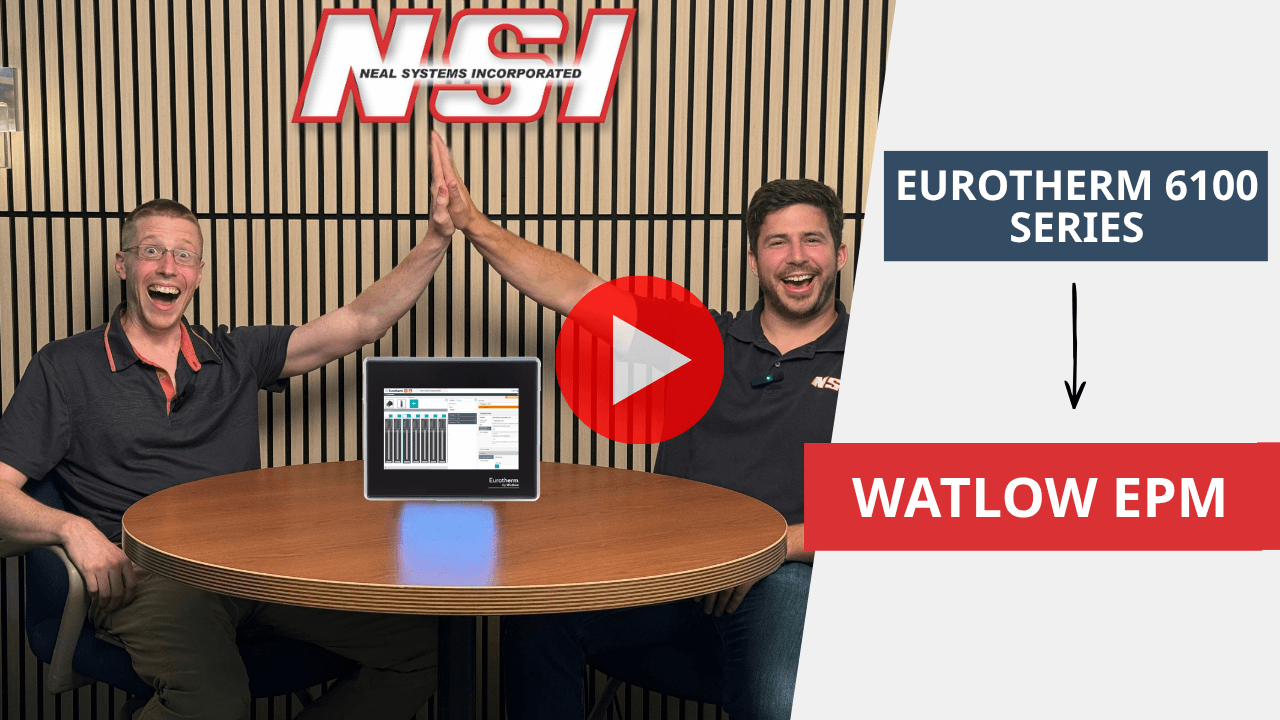
Watch our video with Mark Pfender and Hugh Davison for a quick overview of digital recorders, why they’re still important in modern control systems, and what’s new about the Watlow EPM.
What Does a Digital Recorder Do?
Simply put, a digital recorder stores process data so you can go back and review it later.
This can be important for applications where you need to document a process, meet regulatory requirements, troubleshoot an issue, or simply understand what happened during a process.
As Hugh explains in our video, having access to a process value in the moment isn’t necessarily the same as having a historical record of that data.
Why Use a Recorder If You Already Have a PLC or Control System?
This is a common question.
A PLC or control system reads inputs, processes information, executes control logic, and communicates with other devices. But depending on the system, that doesn’t mean the process data is automatically being stored for historical review.
Seeing data isn’t the same as storing data.
A recorder such as the EPM can be dedicated to collecting and retaining that process history. It can also receive data through communications, so it doesn’t necessarily have to be connected directly to every measurement being recorded.
A simple way to think about it:
PLC / Control System: Controls the process
Recorder: Documents the process
Of course, PLC and SCADA systems can also be designed to store historical data. The right approach depends on the application and what the historical record needs to accomplish.
Is a Recorder Difficult to Configure?
Compared with programming a PLC, configuring a dedicated recorder can be relatively straightforward.
With the EPM, you identify the input, select what type of signal it is, configure the scaling, and you’re ready to record. For example, you can configure inputs for thermocouples or 4–20 mA signals without building the control logic required for a PLC.
The EPM can be configured from the front panel, and Watlow also provides configuration software for the device.
What’s New About the Watlow EPM?
The EPM brings several changes to the traditional recorder platform.
Modular, Hot-Swappable I/O
One of the biggest differences is the expandable I/O architecture. The EPM uses individual I/O modules that can be added or removed as the application changes.
The modules are hot-swappable, allowing I/O to be added or removed without taking the entire recorder offline when the appropriate procedures are followed.
Built for Expansion
The EPM-07 provides 9 I/O slots, while the EPM-15 provides 18 slots. Available modules include universal analog inputs, analog inputs, digital inputs, and relay outputs.
And the platform is designed to do more than basic data recording. Watlow’s EPM platform includes capabilities such as math functions, alarms, timers, counters, totalizers, batch recording, and communications.
Watlow has also indicated that future firmware updates will introduce additional capabilities, including programmable logic control and power control.
What If I Already Have a 6100?
If you have a 6100 Series recorder operating today, obsolescence doesn’t necessarily mean you need to replace a functioning unit immediately.
But when it’s time to replace an existing recorder or specify one for a new application, the Watlow EPM is the platform to consider going forward.
Watlow also provides a migration process for moving existing 6000 Series configurations to EPM, which can help simplify the transition.
The right replacement will depend on your existing I/O, configuration, communications, panel, and recording requirements.
Need Help Replacing a 6100?
At Neal Systems, we can help you determine what you actually need from the replacement rather than simply matching the old recorder.
We’ll look at questions like:
-
What signals are you recording?
-
How many channels do you need?
-
Where is the data coming from?
-
How long does it need to be retained?
-
How is the data accessed?
-
Can the existing configuration be migrated?
-
Can the existing panel be reused?
Watch our video with Mark Pfender and Hugh Davison for a quick overview of digital recorders, why they still matter in modern control systems, and what’s new with the Watlow EPM.
Have questions about replacing a 6100 Series recorder? Contact us to discuss your application.